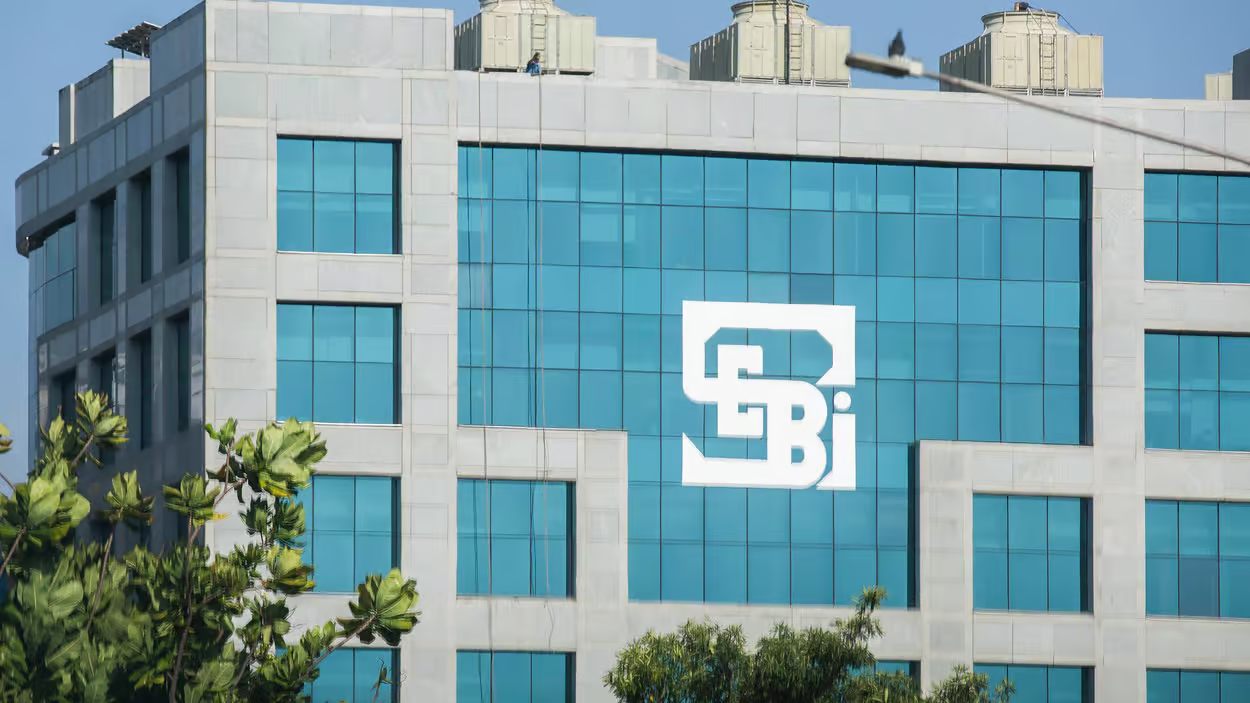
In a significant development that underscores the intricate relationship between governance, regulatory oversight, and politics in India, the Public Accounts Committee (PAC) has had to postpone its meeting intended to scrutinize the Securities and Exchange Board of India (Sebi). The rescheduling arose due to the absence of Sebi chair Madhabi Puri Buch and other officials, who cited pressing reasons for their inability to attend. This incident not only highlights the challenges faced by regulatory bodies but also reveals the political tensions simmering beneath the surface.
Background of the Controversy
The backdrop to this controversy is the recent allegations made by Hindenburg, a US-based short seller, which have raised serious questions about potential conflicts of interest involving Buch. These allegations have sent ripples through the political landscape, with the Congress party seizing the opportunity to demand Buch’s ousting and criticize the government’s handling of regulatory issues. The involvement of a prominent financial player like Hindenburg has lent a new urgency to the PAC’s review of Sebi, a body tasked with overseeing the securities markets in India.
Political Tensions and Accusations
The unfolding events have transformed what is typically a procedural oversight function into a politically charged arena. The BJP has expressed discontent over PAC chair K C Venugopal’s decision to summon Buch for questioning, viewing it as an attempt to politicize the matter. BJP MP Nishikant Dubey has accused Venugopal of bias, suggesting that his actions serve to undermine the central government’s credibility by highlighting issues that he claims are fabricated. This accusation points to a broader narrative in which political parties leverage regulatory scrutiny as a means of advancing their agendas.
Ravi Shankar Prasad, another BJP MP, criticized Venugopal’s unilateral decision-making, calling it a violation of the committee’s principles. He indicated that members of the BJP and its allies are appealing to Lok Sabha Speaker Om Birla for intervention, reflecting the internal discord within the PAC regarding its handling of Sebi’s scrutiny.
The Role of the Public Accounts Committee
Despite the heated exchanges and political maneuvering, it is essential to recognize the PAC’s mandate. The committee is responsible for evaluating the performance of various regulatory bodies established by law, including Sebi. Its work is vital for ensuring accountability and transparency in India’s financial governance framework. The current situation illustrates the delicate balance the PAC must maintain between exercising its oversight authority and navigating the political currents that influence its proceedings.
Implications for Financial Governance
The postponement of the PAC meeting not only highlights the challenges faced by Sebi but also signals potential ramifications for India’s financial governance landscape. As the PAC continues its review amidst political controversies, the outcome could have lasting effects on the regulatory environment in which financial institutions operate. A thorough investigation into Sebi’s operations may uncover critical insights into its effectiveness and raise essential questions about leadership accountability.
The growing scrutiny surrounding Buch and Sebi may prompt calls for reform within the regulatory framework, potentially leading to changes that aim to enhance transparency and restore public confidence in financial governance.
Conclusion
The recent developments within the PAC serve as a reminder of the complex interplay between governance, regulatory oversight, and politics in India. As the committee grapples with its mandate to review Sebi amidst allegations and political tensions, the implications for the future of India’s financial landscape remain uncertain. Stakeholders across the spectrum will be watching closely, as the outcomes of this scrutiny could shape the narrative of regulatory efficacy and accountability in the country for years to come.
In this rapidly evolving scenario, it is crucial for all parties involved to prioritize transparency and constructive dialogue to ensure that the regulatory framework serves its intended purpose: to protect investors and maintain the integrity of India’s financial markets.
Leave a Reply